Are you feeling particularly authoritative? If not, get ready.
At our March 3 Sunday service we will formally install Rev. Rebecca Bryan as our 16th settled minister, and by “we” I mean the membership of the First Religious Society. People from denominational headquarters and other important guests will join us for this special service, but they will not be here to exercise authority. In fact, they have no authority over our congregation whatsoever. They will be here to celebrate with us as we exercise the authority that resides with you and me and all FRS members collectively.
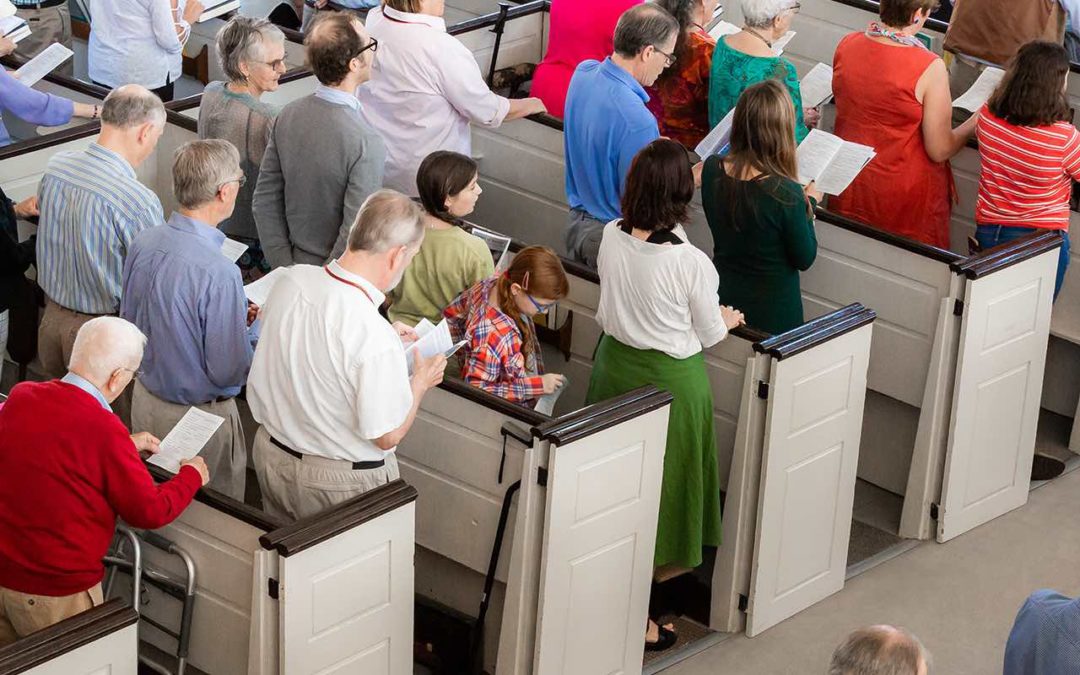
When the time comes in the service for the ritual of installation, those of us who have signed the membership book will stand and read in unison words that accomplish the installation. Many people who have taken part in major UU rituals like installations or ordinations report being deeply moved, and it’s little wonder.
“Rituals transform the everyday into the holy,” says the UU minister Robert Fulghum, who is best known as author of the huge bestseller All I Really Need to Know I Learned in Kindergarten. “Rituals create sacred time.”
Our congregation voted joyously and unanimously to call Rev. Rebecca, so you may be wondering what this installation is about. The call was about selection of a new minister; the installation, half a year after she joined us as our first woman minister in the almost-300-year history of our church, is about our commitment to her and her commitment to us.
Through this age-old ritual we will seal a covenant – a shared promise about how we will work together, about the shared ministry of this church that will determine how the next chapter of our lengthening history will play out. Perhaps it’s no wonder that Rev. Rebecca will be preaching about rituals this Sunday.
If all this seems unfamiliar, it may be because this is the first time FRS has installed a new settled minister in more than two decades. This is a big deal. There are few ways we engage so deeply in our faith.
The very foundation of liberal religion is the understanding that we summon the holy – or, in the words of the Affirmation of Faith that we say every Sunday, “grow into harmony with the divine” – by coming together with all our differences and making a commitment to being in charge of ourselves. We learn from each other by working out our differences – or at least learning to respect the perspectives we disagree with. This deeply relational engagement is a crucial way we expand our ethical and moral imaginations and hone our consciences.
We’re on our own not only as individual religious people but also as a congregation. Unlike hierarchical denominations – the Catholics, Episcopalians, Presbyterians, and Methodists, among others – in Unitarian Universalism each congregation is independent and self-governing. There is no Pope, no bishops, no central authority of any kind. The formal name for this is congregational polity. This dates back to the Pilgrims and runs through the history of both Unitarian and Universalist denominations as well as the UUA.
“Each congregation has a better understanding of its needs than a larger body can,” says the Rev. Keith Kron, the UUA’s director of ministerial transitions.
“The first churches to practice congregational polity abandoned old hierarchies in favor of the democratic understanding that the highest church authority is the people of faith,” says the Rev. Dr. Susan Ritchie, a UU minister who has been a faculty member at the Starr King School of Theology, the UU seminary in Oakland, Calif.
For UUs, authority resides in the conscience of the individual and the collective consciences of our democratic congregations. This congregation has always called its own ministers, by vote of the members, and we have installed them. Our members vote to elect a governing board, delegating to them the responsibility to conduct the congregation’s business; the congregation’s annual membership meeting even approves the annual budget.
And we create our own rituals “I love that our rituals aren’t cookie cutter copies of what all UU congregations do,” Meg Cox, UU author of popular books on ritual, said in a sermon at the UU Congregation of Princeton, N.J., where she is a longtime member.
UU installations customarily are carried out on Sunday afternoons – after church, so that ministers can some celebrate with their colleague. But Rev. Rebecca says she thinks the focus is rightly on the members of the congregation, so she has arranged to meld the ceremony into our regular Sunday service – after which we will march down Pleasant Street to City Hall for a celebration in the auditorium.
Feeling that authority yet?
-By Tom Stites
Please email Jane Tuohy to volunteer with the installation or with your inquiries.