
Third Parish Meeting House: 1754 Lightning Strike
A Look Back at Benjamin Franklin and the Lightning Strike of 1754
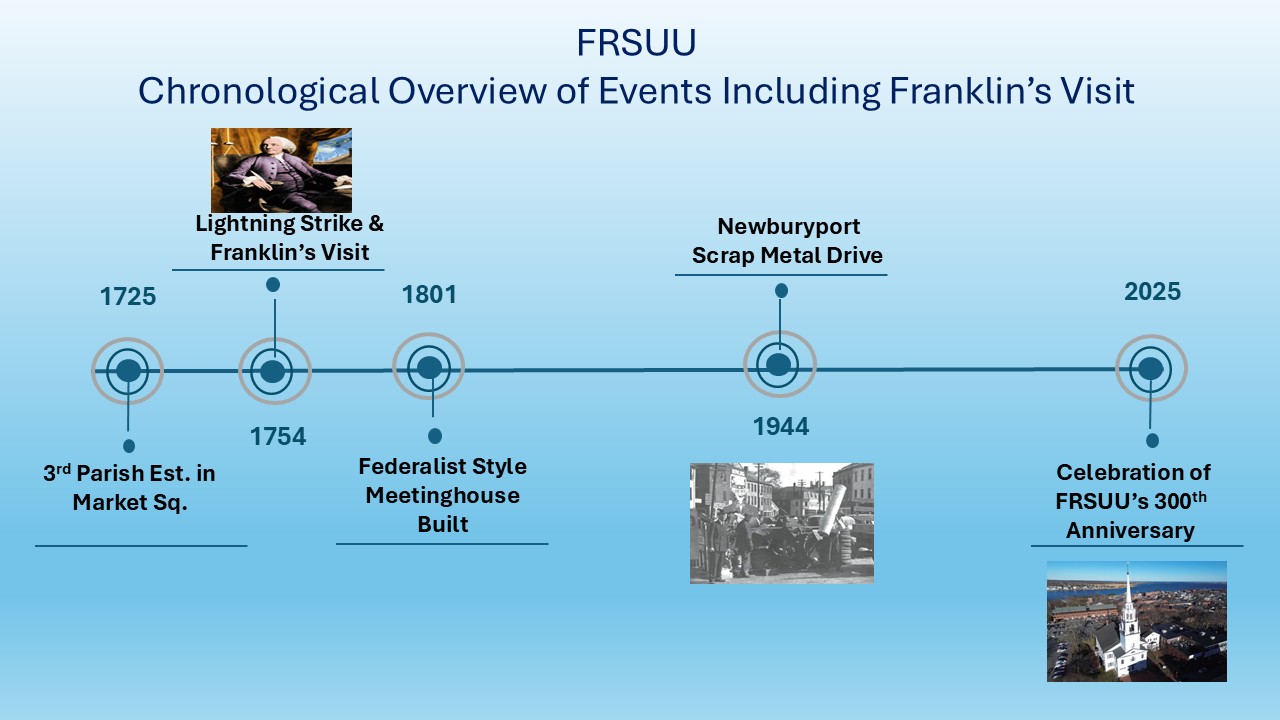
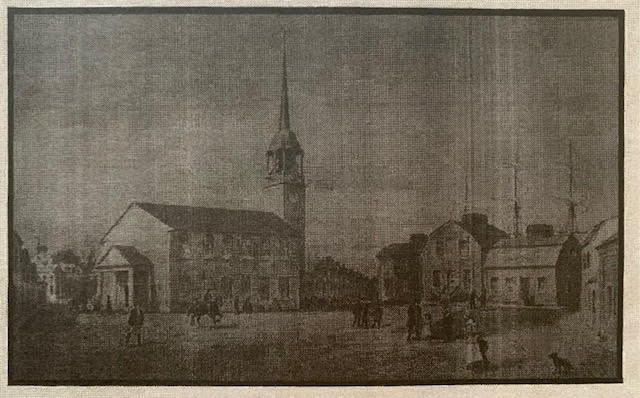
DRAWING ABOVE: An artist depicts the 1724 Third Parish Church (also known as Reverend Lowell’s Meetinghouse) originally located in Market Square, Newburyport. Note: the steeple, belltower, and clock are depicted in the foreground. It is this Meetinghouse that was struck by lightning on February 9, 1754.
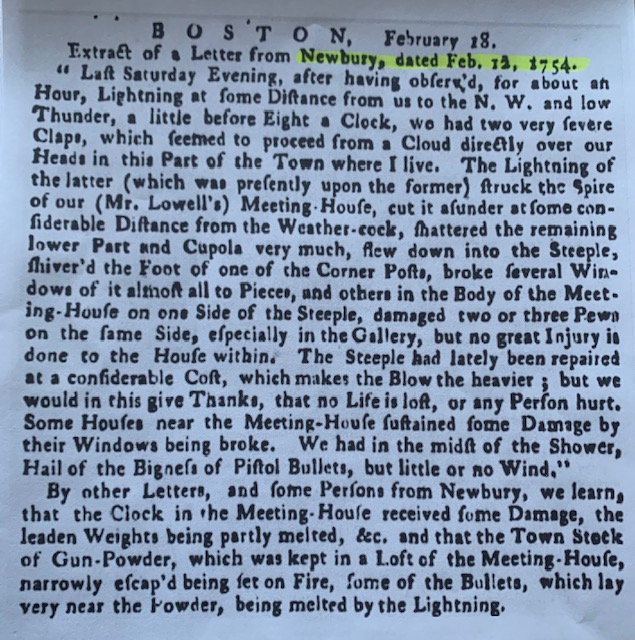
ARTICLE ABOVE: On February 12, 1754, the Boston Gazette reported that a lightning strike damaged the Meetinghouse, narrowly missing the town’s gunpowder stored in the loft.


PORTRAIT ABOVE: Benjamin Franklin was a writer, scientist, inventor, statesman, diplomat, printer, publisher, and political philosopher. As a Founding Father of the United States, he helped draft and sign the Declaration of Independence. Renowned for his studies on electricity, Franklin contributed to physics and invented items like the lightning rod, bifocals, glass harmonica, and Franklin stove. As part of his study of electricity, Benjamin Franklin came to Newburyport to examine the damage. Based on his observations, Franklin learned of the conductive properties of metal.
LETTER ABOVE: Correspondence between Benjamin Franklin and his scientific associate, James Birkett, concerning the impact, is archived at the Smithsonian Institution.

LETTER ABOVE: In correspondence preserved at the Smithsonian, Benjamin Franklin writes to his scientific colleague M. Dalibard of Paris, documenting his observations of the wire (connecting the bell’s hammer to the clock mechanism), that safely conducted the electricity associated with the lightning strike. Click on letter image to read the entire letter.
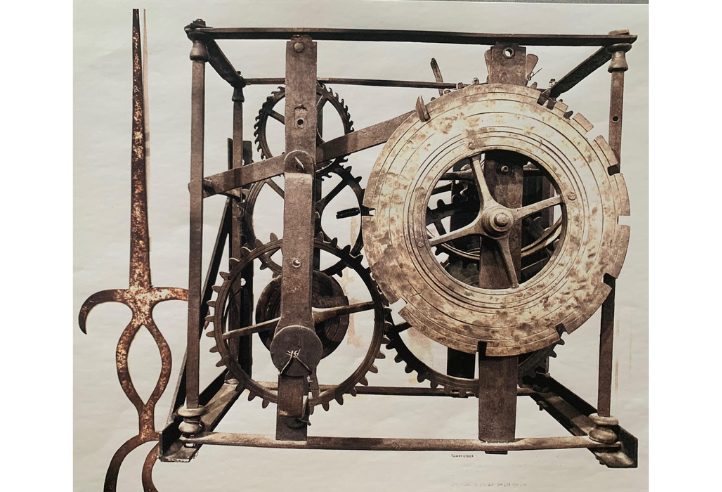
CLOCK WORKS – PHOTO ABOVE: This image shows what an 18th-century tower clock mechanism, housed in a cage, typically looks like. The “Restoration” photo indicates that most of the original Third Parish clock gears are missing, with only some of the clock components still present.
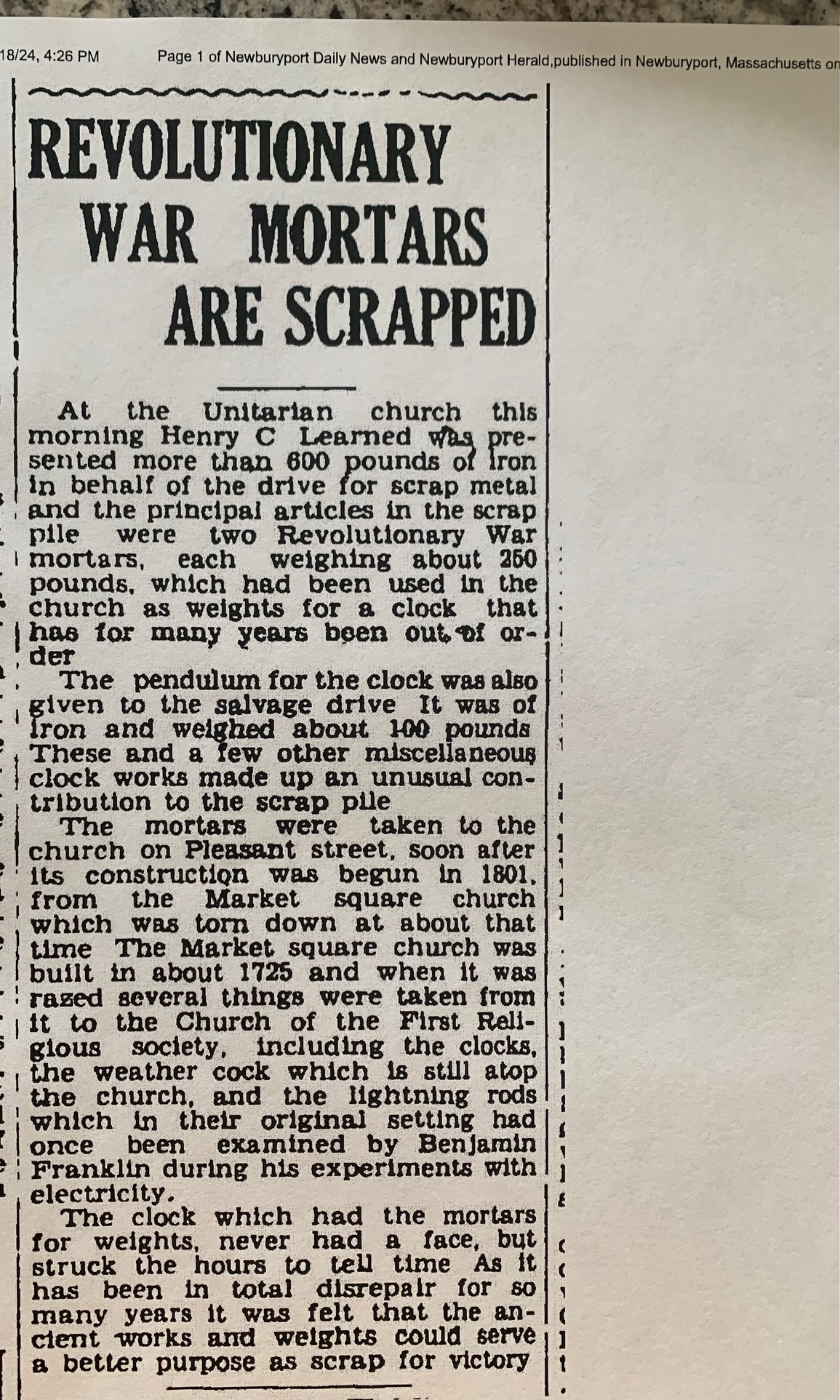
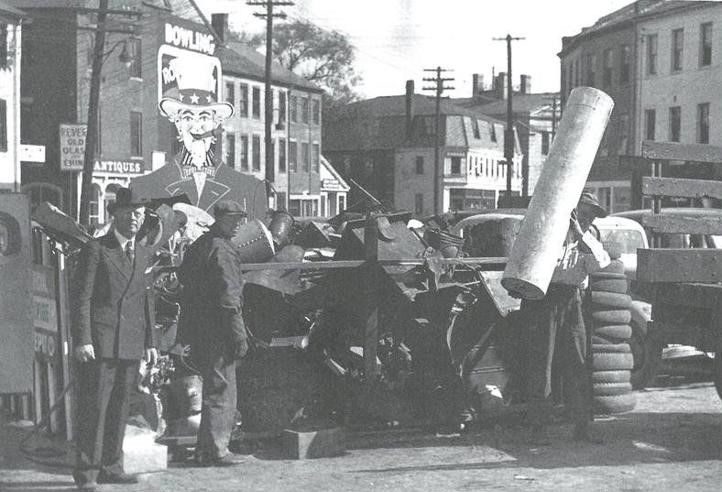
ARTICLE ABOVE: According to an article published in the Newburyport Daily News and Newburyport Herald on September 19, 1942, the First Religious Society contributed between 100 and 600 pounds of scrap metal—including clock components—to a World War II salvage effort. Notably, the pendulum for the clock was estimated to weigh approximately 100 pounds.
PHOTO ABOVE: Scrap metal collection at Newburyport Market Square during World War II (around 1944).
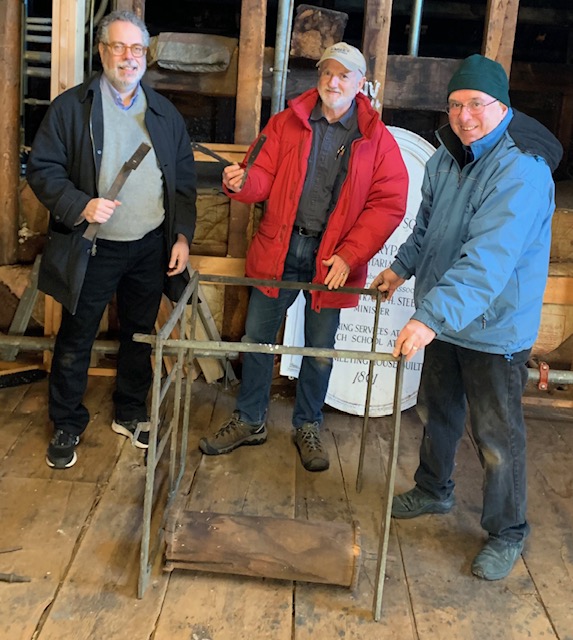
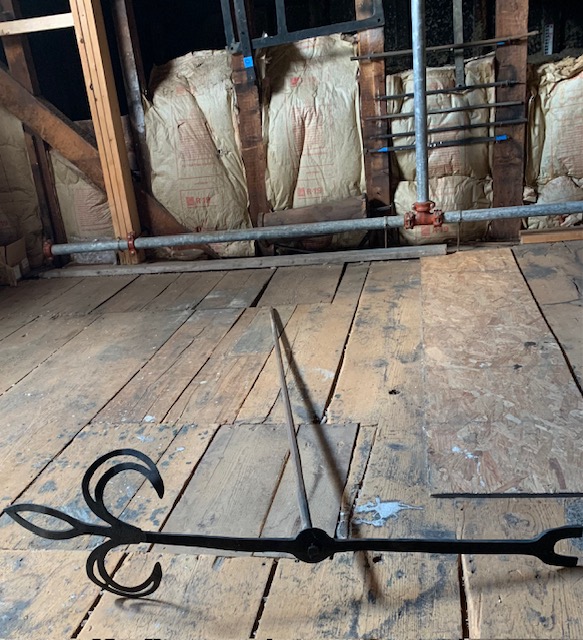
RESTORATION EFFORT – PHOTO ABOVE: In February 2024, Horologist, Robert Frishman, Damon DiMauro, Jack Santos, and others attempted to re-assemble the surviving clock parts to create a display. However, with less than 20% of the original components surviving and those being insufficient, reconstruction was not possible. Note: Clock parts were found hanging in the steeple attic and tucked away in a closet in the back of the Sanctuary.
CLOCK HAND – PHOTO ABOVE: This hour hand, forged around 1725 and likely originating from England, is the exhibit’s featured clock component. Occasionally, smaller remaining clock parts will be displayed at the base of the exhibit for emphasis.
A Heartfelt Thank You!
With the gratitude and appreciation of the First Religious Society, Unitarian Universalist congregation for work on the “Third Parish Meeting House: 1754 Lightning Strike” Exhibit in celebration of our 300th anniversary!
Newburyport Bank
Jim Dryer Fund
Bart Bauer, Consultant
Mark Brophy, Advisor
Patrick Creamer, Cabinet Construction
Roger Dardinski, Welder
Bruce Deveau, Artist / Advisor
Damon DiMauro, Research
Robert Frishman, Horology Scholar & Preservationist
Andy Lobb, Project Manager
Paula Renda, Advisor
James Russell, Exhibit Display
Jack Santos, Advisor
Ghlee Woodworth, Project Manager/Historian